one region, four towns, no morning spent hauling bags to a platform
Reserve nine nights on the ground in Emilia-Romagna, Bologna to Parma by local train
People who ask for Paris, Rome and Venice in ten days want three famous cities and a full sense of each. You can reserve this instead: four towns inside one region of northern Italy, none of them more than an hour apart, with the walking done in the towns rather than in stations.
Nine nights, from $3,910 per person.
When someone asks this desk for Paris, Rome and Venice in ten days, they are usually holding a picture with three things in it: a long lit avenue, a very old stone building with a crowd in front of it, and water with boats on it. That picture is accurate. All three exist. The question the desk has to answer is not whether those places are worth seeing, because they plainly are, but what ten days does to them once the moving is counted.
Here is the arithmetic as it actually falls. Landing day is gone to customs, a train or taxi into town, and a nap you did not plan on. The Paris to Rome leg is a flight of about two hours plus three hours of airport on either end, or eleven hours by rail with a change. Rome to Venice is quicker, three and a half hours end to end if the connection is kind. Add the morning you spend checking out, dragging a bag to a station, and the afternoon you spend finding the new place and getting your bearings, and three moves cost you the better part of four days out of ten. What is left is roughly two working days per city. Two days is enough to stand in front of the famous thing and photograph it. It is not enough to come back to anything, and coming back is where most of the pleasure of a place is stored.
So the swap on offer is not a smaller version of the wish. It is a different holiday and it should be named as one. Nine nights in Emilia-Romagna, four towns, none of them further apart than forty minutes on a local train, and three of your nine mornings begin in a room you already know. You will not see Notre-Dame or the Grand Canal. You will see one part of one country closely enough that by the eighth day you will be buying bread from someone who recognizes you.
What people ask for
Paris, Rome and Venice in ten days
The wish is a good one and it is not naive. Those three cities hold work nobody can see anywhere else, and wanting all of it at once is what a first trip to Europe is honestly for.
This office does not arrange the three capital run because the timetable eats it: two international legs plus the transfers around them take roughly four of the ten days, and no town on the route gets a second morning.
What this desk will reserve instead
Nine nights on the ground in Emilia-Romagna
One region, four towns, no morning spent hauling bags to a platform.
Nine nights, from $3,910 per person. Send a booking request
How far this sits from the request: a different kind of trip altogether
Nine nights in four towns: three in Bologna, two in Modena, two in Parma, two back in Bologna near the station. Beds are family run guest houses and one small hotel. Trains are regional, second class, and each person carries their own bag.
Bologna Guglielmo Marconi Airport sits about four miles northwest of the old center, twenty minutes by the elevated shuttle. The ground is flat farm country between low hills, and the towns themselves are brick, arcaded, and walkable end to end. Beds are eight to fourteen rooms apiece, breakfast at a shared table, no elevator in two of the four. The season runs mid March to the second week of November, closed in August when the towns empty. Nine nights, from $3,910 per person.
Nine nights in four properties, two people sharing; breakfast every morning; all regional rail between the four towns, second class; one afternoon at a working parmesan dairy including the aging room; one visit to a balsamic loft in the hills above Modena; a two hour walk of central Bologna with a guide who works in Italian and English; one shared lunch in Parma; one shared dinner in Modena; the airport shuttle in both directions; and a written schedule with each train time and platform.
The fare out from the United States, running $780 to $1,410 for a round trip out of St Louis depending on month; lunches and dinners not named above, budget $22 to $45 a head; museum and church admissions, which run $4 to $16 each and add up to roughly $70 over the nine days; anything you drink beyond what comes with the two shared meals; the tourist bed tax collected at each property, $2.50 to $5.00 per person per night in cash; laundry; and tips.
This trip asks for four to seven miles of walking a day on cobbles and brick, much of it uneven, some of it under arcades with a step at every doorway. Two of the four beds are up one or two flights with no elevator, and you carry your own bag up them. There are four train changes over nine nights, each with a platform walk of a few hundred yards and a step up into the carriage. If stairs, cobbles, or lifting a suitcase are a problem, this is the wrong reservation and we would rather say so now.
The flat country between Bologna and the hills
Emilia-Romagna is farmland with towns dropped into it, laid along a single old Roman road that runs southeast from Piacenza to the Adriatic. Bologna sits in the middle of it. The land north of the road is dead flat, cut by drainage ditches and planted in wheat, sugar beet and fodder for the dairy herds. South of it the ground lifts into low hills within about eight miles, and it is in those hills that the balsamic lofts sit, because they need a building that gets hot in summer and cold in winter.
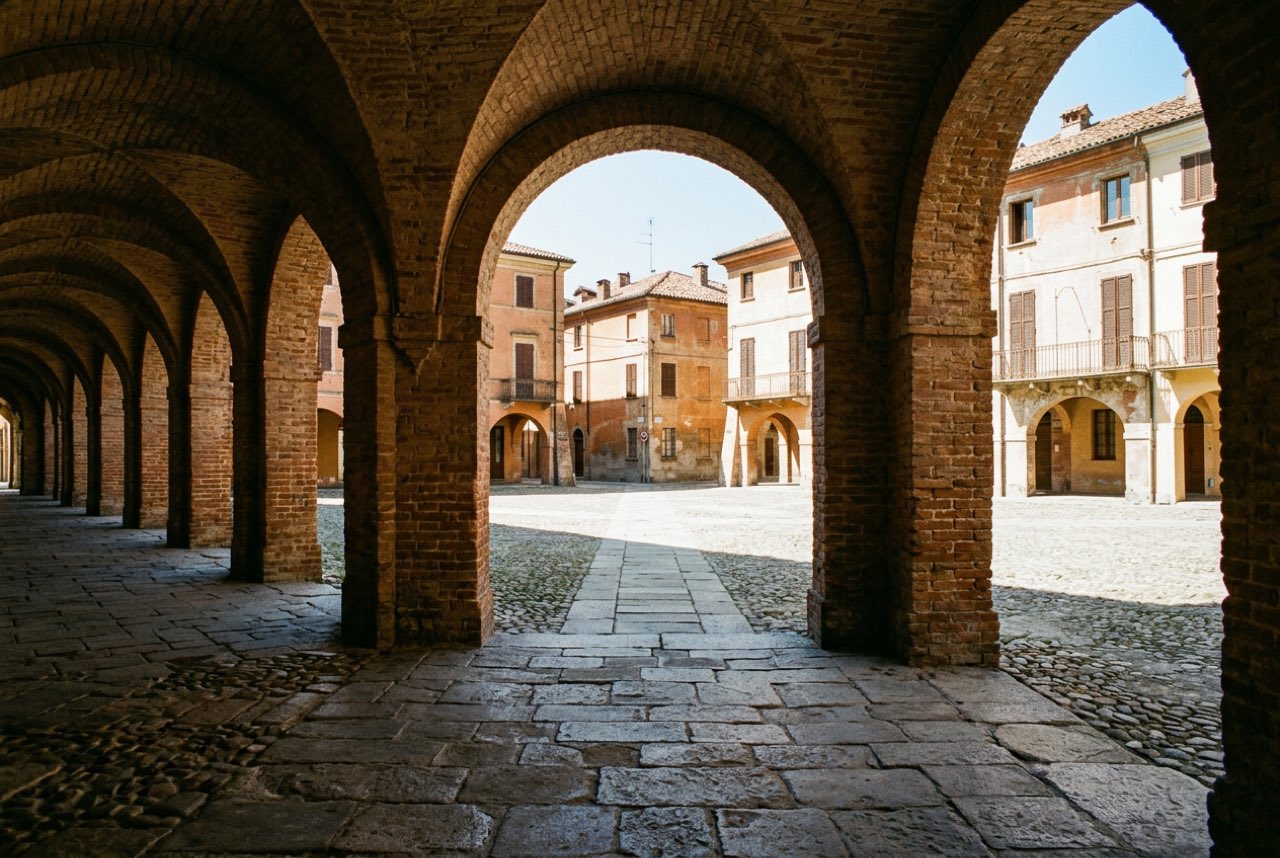
The towns are built of brick because there is no building stone here, and Bologna in particular is roofed over: something on the order of twenty-four miles of arcade in the old center, which means you can cross most of the city in rain without opening anything. That single fact changes what a wet day costs you. In Paris a wet day is spent indoors paying admission. Here it is spent walking.
As a record rather than a forecast: the last several years have had March in the low fifties with real rain, May and early June in the seventies and pleasant, July and August genuinely hot at ninety and above with humidity off the flat ground, September warm and heavy with the grape harvest, and late October into November cool, foggy in the mornings, and the best light of the year. August is when the towns close, which is why this trip does not run then.
The kind of traveler this suits, said plainly
This suits somebody who has been to Europe once already, or who has not but knows what they actually enjoy: sitting in one square long enough to watch it change, eating the same regional food eleven times and noticing the differences, walking four miles without thinking about it. It suits people traveling in twos who do not want a coach. It suits a certain kind of first trip too, the kind taken by somebody who would rather know one place than have seen three.
It does not suit anybody whose reason for crossing the Atlantic is the specific list of monuments in the wish. That is a legitimate reason. If it is yours, this office would rather point you to a single one of those three cities for nine nights than sell you a region you did not want, and we will say so on the phone rather than take the reservation.
The year here, as it has actually run
Opening weeks. Fifty to sixty-two degrees, rain most weeks, few visitors, and the hill roads above Modena often still wet. Beds at their lowest availability because several properties open late.
The most reliable stretch on record: high sixties to high seventies, long light, everything open. Books out earliest, usually four to five months ahead for the Bologna rooms.
Warm, high seventies to mid eighties, and the tail of school groups in the city museums. Evenings are long and the outdoor tables run late. Dairy visits move to early morning.
Hot, upper eighties and humid off the flat land. Walking is done before eleven and after six. Several family run kitchens shorten their week. Not recommended and not scheduled.
The region empties. Shutters down for two to three weeks in every town on this route. This trip does not operate.
Harvest. Warm days in the high seventies, cool nights, the balsamic lofts busy and worth seeing busy. Second most requested month.
Cooling into the sixties, morning fog on the plain, mushrooms and the first oil of the year on every menu. Quietest month with everything still open.
Close of season. Fifties, damp, fog until ten some mornings, and the arcades earn their keep. Last departures leave in the second week.
What is genuinely annoying about this trip
The food is the reason most people come and it is also the constraint. Kitchens here keep proper hours: lunch from about twelve-thirty to two-thirty, dinner from seven-thirty, and almost nothing in between except a bar sandwich. If you are used to eating at five-thirty, or to wandering in at three and being fed, you will spend the first three days irritated. There is no way to arrange around this, because it is not a rule anyone imposes on you, it is simply when the cooking happens. The desk mentions it because people report it as the single biggest surprise, ahead of the walking.
The second thing is the trains. Regional service between these four towns is frequent and cheap, and it is also entirely unglamorous: no assigned seats, no luggage racks worth the name, platform changes announced in Italian on a board that updates late. Delays of ten to twenty minutes are ordinary and are not compensated. Your written schedule lists a train and a fallback train for every move, which is the honest way to handle it. If your idea of moving between towns involves a porter and a reserved carriage, this is not that, and the price reflects the fact that it is not.
Ask the desk to reserve something
This form is open 24/7 and takes booking requests at any hour. It asks for no card number and no payment, because nothing is ever paid to this office. Requests are read in the order they arrive and answered within one business day.
No card number is asked for on this page or held anywhere by this office, and sending this costs nothing and commits you to nothing. A request is not a reservation: nothing is held in your name until the operating company confirms it in writing and you have read its terms.